
How to Use a Slow Cooker: Tips, Cooking Times & Conversion Chart
A slow cooker is one of the easiest ways to get a real, home-cooked dinner on the table on a busy day. You add the ingredients in the morning, turn it on, and come home to tender meat, soft vegetables and a kitchen that smells like someone has been cooking all afternoon.
It’s simple, but a few details make a big difference: how full you fill it, where the vegetables go, how much liquid to add, and how to adapt a regular recipe. This guide covers all of it, plus a cooking time conversion chart and the food safety basics every slow cooker owner should know.
In this guide
- LOW vs HIGH: what’s the difference?
- Choosing the right slow cooker
- How full should a slow cooker be?
- How to layer ingredients
- Slow cooker conversion chart
- Best cuts of meat for the slow cooker
- What to add at the end
- Slow cooker food safety
- 10 common slow cooker mistakes
- Frequently asked questions
LOW vs HIGH: what’s the difference?
Both settings eventually bring the food to roughly the same temperature, just below or around a simmer. The difference is how long it takes to get there. HIGH heats up faster, so food cooks in about half the time it would on LOW. As a rough rule, 1 hour on HIGH equals about 2 hours on LOW, though every model runs a little differently.
- Use LOW for tough cuts of meat like chuck roast, lamb shoulder and short ribs. The long, gentle cook gives the connective tissue time to melt, so the meat turns fork-tender instead of stringy.
- Use HIGH for chicken, soups, chili and recipes with more vegetables than meat, or when you’re starting later in the day.
- Use WARM only to hold food that’s already fully cooked, never to cook raw food.
Choosing the right slow cooker
- Size: a 6-quart slow cooker is the most versatile for a family of four to six, and it’s the size most recipes are written for. A 3- to 4-quart model suits one or two people, and 7 to 8 quarts is great for big batches and large roasts.
- Shape: oval cookers fit whole roasts and chickens better. Round ones work well for soups, stews and chili.
- Programmable timer: a model that switches to WARM automatically when the cooking time ends is very useful if you’re out of the house all day.
- Removable insert: a ceramic or stoneware insert that lifts out makes serving and cleaning much easier. Some newer inserts can even go on the stovetop for browning, which saves a pan.
How full should a slow cooker be?
Aim to fill your slow cooker between half and two-thirds full. This is the range most slow cookers are designed to heat evenly and safely.
- Too empty: a small amount of food heats up too quickly and can overcook, dry out or scorch on the bottom. If you often cook small amounts, a smaller slow cooker is a better fit.
- Too full: food at the top may not heat up fast enough to stay out of the temperature range where bacteria grow, and the pot can bubble over.
How to layer ingredients

The heat in a slow cooker comes from the bottom and sides, so the order you add things matters.
- Root vegetables on the bottom. Potatoes, carrots, onions and other dense vegetables take the longest to cook, so they go closest to the heat.
- Meat on top of the vegetables. The juices drip down and flavor everything below.
- Liquid around the sides. Pour broth or sauce around the edges rather than over the meat, so you don’t rinse off the seasoning.
- Delicate ingredients last. Quick-cooking vegetables, dairy and fresh herbs are added near the end (more on that below).
You can see this layering in action in this crockpot creamy chicken and potatoes and this easy crockpot chicken stew, where the potatoes and carrots sit under the chicken.
Slow cooker conversion chart
Want to turn a stovetop or oven recipe into a slow cooker recipe? Use this chart as a starting point. These are general guidelines, so check for doneness toward the end of the range, especially the first time you make something.
| Original cook time (oven or stovetop) | Slow cooker on LOW | Slow cooker on HIGH |
|---|---|---|
| 15 to 30 minutes | 4 to 6 hours | 1 1/2 to 2 1/2 hours |
| 30 minutes to 1 hour | 5 to 7 hours | 2 to 3 hours |
| 1 to 2 hours | 6 to 8 hours | 3 to 4 hours |
| 2 to 4 hours | 8 to 12 hours | 4 to 6 hours |
Other things to adjust when converting a recipe
- Cut the liquid. Very little evaporates under a closed lid, and meat and vegetables release their own juices. Start with about one-third to one-half less liquid than the original recipe. You can always add more at the end.
- Boost the seasoning at the end. Long cooking can mellow flavors. Taste before serving and add salt, a squeeze of lemon, a splash of vinegar or fresh herbs to brighten things up.
- Thicken at the end. If the sauce is thin, stir in a slurry of cornstarch and cold water and cook on HIGH with the lid on for 15 to 20 minutes.
Best cuts of meat for the slow cooker
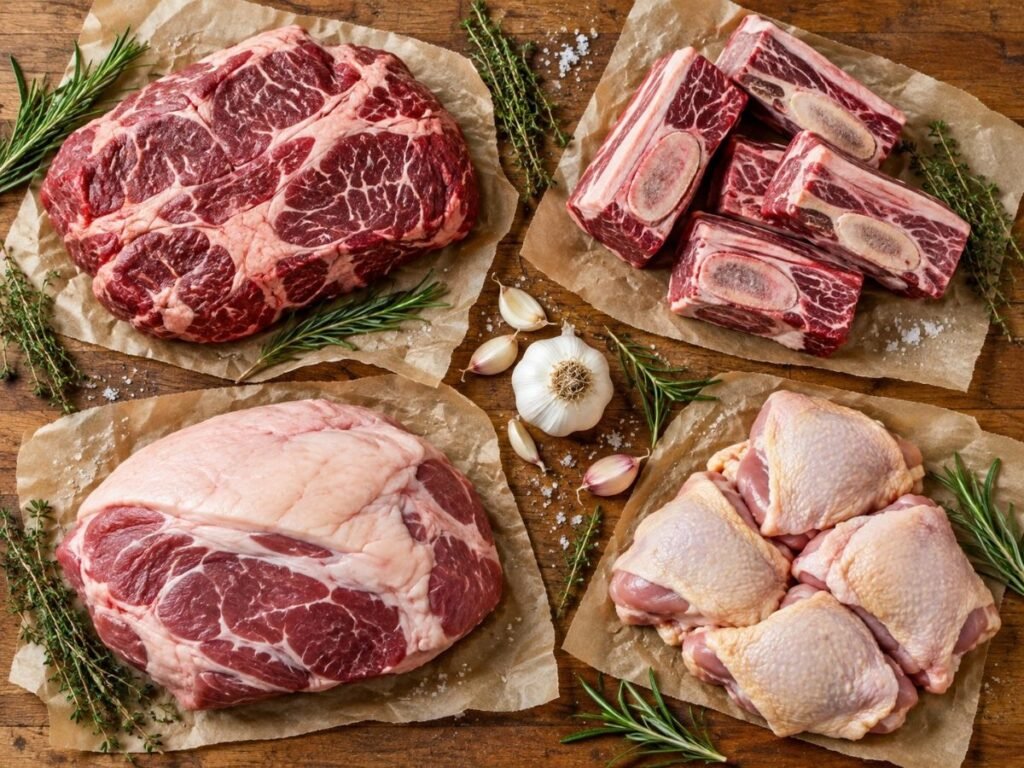
Slow cookers are made for the inexpensive, hard-working cuts that turn tough when cooked quickly. Their fat and connective tissue melt over the long cook and keep the meat juicy.
| Meat | Best cuts | Cuts to avoid or watch closely |
|---|---|---|
| Beef | Chuck roast, short ribs, brisket, stew meat from chuck | Sirloin, tenderloin, lean steaks |
| Lamb | Shoulder, shanks, stew meat from the shoulder | Loin chops, rack of lamb |
| Chicken | Boneless or bone-in thighs, drumsticks | Boneless breasts (cook on the shorter end of the time range) |
| Lamb | Shoulder, shanks | Rack, loin |
Should you brown meat first? It isn’t required for safety, but it adds a lot of flavor. Searing creates a deep brown crust, and those browned bits make the sauce richer. It’s why this slow cooker French onion pot roast and this classic beef stew both start with a quick sear. On busy mornings, skipping it is fine, especially for chicken.
What to add at the end
- Dairy: milk, cream, sour cream and cheese can curdle or turn grainy over hours of heat. Stir them in during the last 15 to 30 minutes.
- Quick-cooking vegetables: peas, spinach, zucchini and other tender vegetables turn mushy if they cook all day. Add them in the last 15 to 30 minutes.
- Pasta and rice: they absorb too much liquid and get soft. Cook them separately, or add pasta in the last 20 to 30 minutes on HIGH.
- Fresh herbs: add delicate herbs like parsley, basil and cilantro right before serving. Hardy dried herbs, like thyme and rosemary, can go in at the start.
Slow cooker food safety
Slow cookers are safe when used correctly, because they cook at temperatures high enough to destroy bacteria. A few rules keep it that way:
- Never start with frozen meat. Frozen food takes too long to heat up and can spend hours in the “danger zone,” between 40°F and 140°F (4°C and 60°C), where bacteria multiply quickly. Thaw meat in the fridge first.
- Keep ingredients cold until you start. If you prep the night before, store the meat and vegetables in separate containers in the fridge. Don’t refrigerate the filled ceramic insert, because a cold insert takes too long to heat up.
- Cook to safe temperatures. Use a thermometer to check: chicken and turkey need 165°F (74°C), and ground meat 160°F (71°C). You can find the full list on the FoodSafety.gov safe temperature chart.
- Boil dried kidney beans first. Raw and undercooked red kidney beans contain a natural toxin that a slow cooker’s low temperature doesn’t destroy. Soak them, then boil them hard for at least 10 minutes before adding them to the slow cooker, or use canned beans.
- Don’t reheat leftovers in the slow cooker. It heats too slowly. Reheat leftovers on the stove or in the microwave until steaming hot (165°F / 74°C), then you can keep them warm in the slow cooker on WARM.
- Refrigerate leftovers within 2 hours. Don’t leave the insert to cool on the counter for hours. Transfer leftovers to shallow containers so they cool quickly.
- If the power goes out while you’re away, throw the food away, even if it looks done, because you can’t know how long it sat at unsafe temperatures.
10 common slow cooker mistakes
- Lifting the lid. Every peek lets out heat and steam, and the cooker needs time to recover. Keep it closed unless the recipe says otherwise.
- Adding too much liquid. The result is watery, bland sauce. Use less than you would on the stove.
- Using lean cuts. Chicken breasts and lean beef dry out over long cooking. Choose thighs, shoulder or chuck.
- Cutting vegetables too big. Large chunks of potato or carrot can still be firm when the meat is done. Cut them into even 1- to 1 1/2-inch pieces.
- Putting vegetables on top. Root vegetables belong on the bottom, closest to the heat.
- Adding dairy too early. It curdles. Stir it in at the end.
- Overfilling or underfilling. Stick to half to two-thirds full.
- Not seasoning enough. Long cooking dilutes flavor. Season well at the start and taste again at the end.
- Cooking raw pasta all day. It turns into mush. Add it late or cook it separately.
- Leaving food on WARM too long. WARM is for holding cooked food for a few hours, not all day.
Frequently asked questions
Is it safe to leave a slow cooker on all day while I’m at work?
Slow cookers are designed to run unattended for long periods. Place it on a flat, heat-safe surface away from the wall and anything flammable, make sure the cord is in good condition, and follow your manufacturer’s instructions.
Can I cook a recipe on HIGH instead of LOW?
Usually, yes. Plan on roughly half the time. Tough cuts of beef and lamb will be tenderer on LOW, but chicken, soups and stews work well on either setting.
Can food overcook in a slow cooker?
Yes. Lean meat dries out, vegetables turn mushy, and sauces can scorch at the edges if a dish cooks far longer than needed. If you’ll be gone longer than the recipe time, use a programmable cooker that switches to WARM automatically.
Why is my slow cooker food watery?
Meat and vegetables release liquid as they cook, and the lid traps it all. Reduce the liquid next time, and to fix it now, cook uncovered on HIGH for 20 to 30 minutes or stir in a cornstarch slurry.
Can I put raw chicken in a slow cooker?
Yes, as long as it’s fully thawed. Cook until the thickest part reaches 165°F (74°C). Thighs are the most forgiving, while breasts are best on the shorter end of the cooking range.
Do I need to add liquid to a slow cooker?
Most recipes need some liquid to create steam and prevent scorching, but not as much as you’d think. A cup or so of broth is often enough for a roast, since the meat releases its own juices.
Helpful tools
- 6-quart programmable slow cooker: the most versatile size, and it switches to WARM on its own.
- Instant-read thermometer: the only reliable way to check meat is cooked to a safe temperature.
This post contains affiliate links. As an Amazon Associate I earn from qualifying purchases.
Slow cooker recipes to try
- Crockpot Creamy Chicken and Potatoes: a true dump and go dinner with a parmesan cream sauce.
- Slow Cooker French Onion Pot Roast: fall-apart beef in caramelized onion gravy with cheesy toasts.
- Crockpot Chicken Stew: a lighter, hearty stew full of vegetables.
- Classic Beef Stew: rich and fork-tender, with slow cooker directions included.
Have a slow cooker question that isn’t covered here? Leave it in the comments and I’ll do my best to help.